


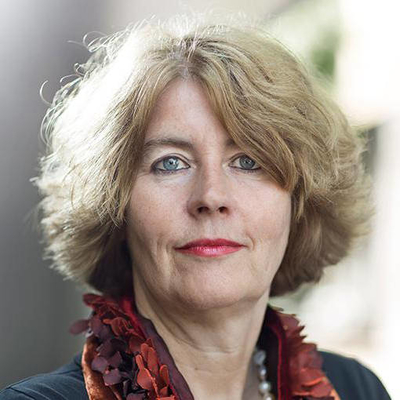
On 22 October Birgit Meyer moderated a panel discussion with the theme Polycrisis-Polyopportunities? Mobilizing Knowledge, organized by the Holberg prize at the Netherlands Academy of Arts and Sciences (KNAW). The speakers were Rens Bod, Francio Guadeloupe and Sari Hanafi. It was a lively and productive discussion.
The recording has just been published on the Holberg prize site: https://www.youtube.com/watch?v=61dGDdKZ_pI
Here is Meyer’s introduction to the event:
Welcome to our panel discussion Polycrisis – Polyopportunities? – Mobilizing Knowledge
Our planet is in a bad state, and in the midst of depressing and devastating news on so many fronts, it is difficult to maintain sanity, clarity of mind and hope. Referring to a set of intersecting crises, polycrisis is all around; it has many looks that are captured in images, all telling elements of a larger story that is difficult to grasp in full.Polycrisis gives a name to what many perceive as an unprecedented World-Disorder; however, this view is problematic, as it wrongly proposes that there has ever been a fixed world-order that is now broken, in any case, the security offered by this order was always partial and only enjoyed by some.
But what is clear is that the idea of progress that long underpinned modernity, with capitalism framed as its harbinger, is now fully disenchanted and that a sense of deep uncertainty and danger is part of our everyday predicament, admittedly to different degrees, depending on class and the part of the world one lives in. And alongside this development, there is an increasing critique of the capacity of Eurocentric epistemologies to explain the world, coupled with the awareness that we must re-think our world from an angle of pluriverse and multiplicity.
Since around 2020, in the context of the SarsCov2 pandemic and strong awareness about global warming and the ensuing climate catastrophe, the term polycrisis has been circulating across arenas of policy making, the World Economic Forum, and some The KNAW as the “forum, the voice and the conscience of science in the Netherlands” is the place for this event which is intended as a kickoff for exchange, prompted by a sense of a need to address challenges on a planetary scale as scholars and concerned citizens.
To mitigate the inflationary use of polycrisis as a buzzword, it’s good to return to the initial coinage of the concept by Edgar Morin and Anne-Brigitte Kern in the early 1990s. It’s impossible to offer an exegesis of their manifest Terre patrie, that was translated as Homeland and earth: A Manifesto for the New Millenium. Advances in systems theory, complexity, and the human sciences here. So just some key points: Morin and Kern stress the need for a planetary perspective that understands our world as a complex system of interconnections that arose post 1500. Disorder and uncertainty are endemic to the system, not aberrations that can be solved so as to reach a stable order. At stake is not a single crisis about a single vital problem, rather there is a complex “intersolidarity of problems, antagonisms, crises, uncontrolled processes, and the general crisis of the planet that constitutes the number one vital problem.”
Grasping this complexity is difficult, as it requires 1) transcending the nature-culture distinction, that still organizes academic knowledge production, 2) thinking universal, yet not Eurocentric (i.e. limiting rationality to European superiority); and 3) communicating our insights and ideas on a meta-level, aiming at a renewed humanism. If it is our task as academics to contribute knowledge to understanding the world – with its patterns and principles – in the broadest sense, the current situation requires us to get together to think hard and mobilize our knowledge, also about the infrastructures of knowledge production in which academic freedom is increasingly under siege.
Which new directions could our thinking take and which fresh imaginations could we develop? In what ways could the current polycrisis not only be a topic for (depressing) analysis, but also open up new opportunities and possibilities? And what can scholars in the humanities contribute to understand what we share, and what separates us, as humans?
These questions are at the core of this event. Of course, our exchange of views will and cannot resolve polycrisis, but it aims to help us get our heads around the issues at stake on a metalevel. As the “forum, the voice and the conscience of science in the Netherlands,” the KNAW is the place for this event which is intended as a kickoff for future exchanges, prompted by a sense of a need to address challenges on a planetary scale as scholars and concerned citizens.
I am incredibly happy to welcome our speakers, whom I will only introduce briefly, as you find their bionotes on the program. Rens Bod is professor of digital humanities and the history of the humanities at the University of Amsterdam. Francio Guadeloupe is senior researcher at the KILTV and endowed professor of Kingdom relations at the University of Amsterdam. Sari Hanafi is Professor of Sociology, Director of Center for Arab and Middle Eastern Studies and Chair of the Islamic Studies program at the American University of Beirut, and currently a fellow at NIAS.Each will speak to our larger theme from his specific expertise, and we kick this discussion off by three brief statements.