


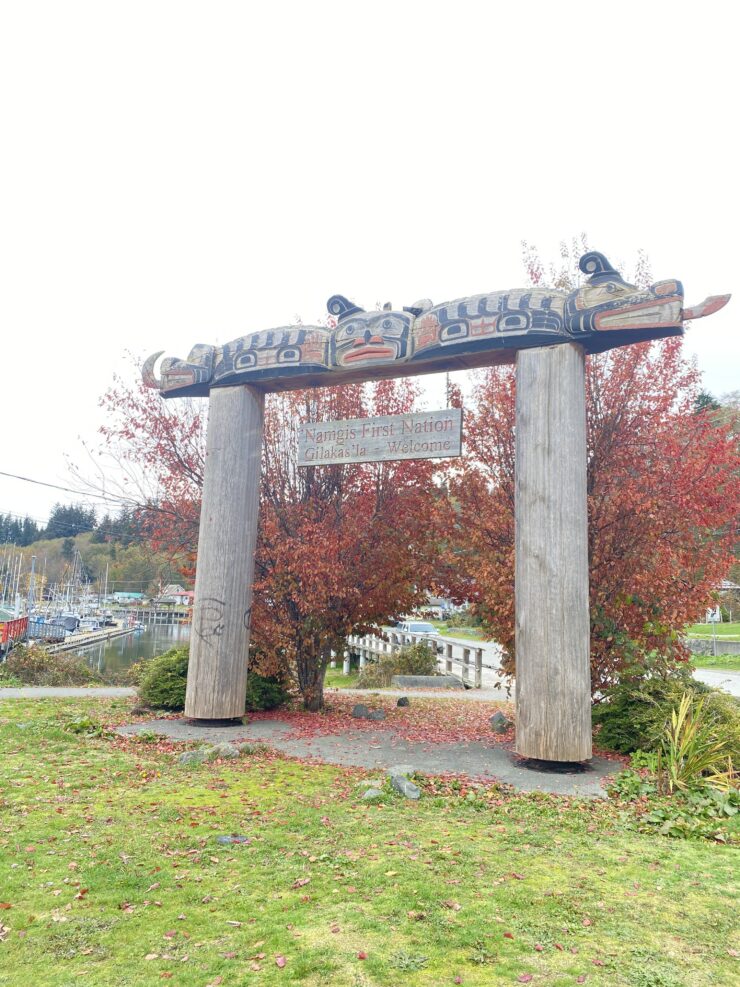
In December 1921, on a remote stretch of coast called ‘Mimkwa̱mlis, Chief Dan Cranmer held what is still remembered as one of the largest potlatches ever recorded on the central coast of British Columbia. Canoes, gramophones, sewing machines, violins, blankets, cash. Hundreds of gifts were exchanged over days of singing, dancing and feasting. It should have been an ordinary, if extraordinary, expression of Kwakwaka’wakw law and generosity. Instead, it became a crime scene. Canadian authorities had banned the potlatch, and informants among the guests made sure the police found out. Forty-five people were charged, twenty-two went to prison. And as part of the settlement, the communities were pressured into surrendering the masks, rattles, headdresses and regalia that had made the ceremony possible (Cole and Chaikin 1990; Webster 1995).
Those pieces were first stored in an indian agent’s woodshed. Later they were put on display in the Alert Bay parish hall, where community members were charged admission to say goodbye to their own belongings. Items that, traditionally, only their rightful owners were even permitted to look at outside of ceremony (Sanborn 2009). From there they were shipped east, sold, gifted, scattered across museums and private collections in Canada, the United States and Britain.
I spent six months on Vancouver Island researching what happened after that: what it actually looks like when a community gets its cultural material back, decades later, and what “back” even means once material has spent eighty years inside Western institutions.
A word for what was missing
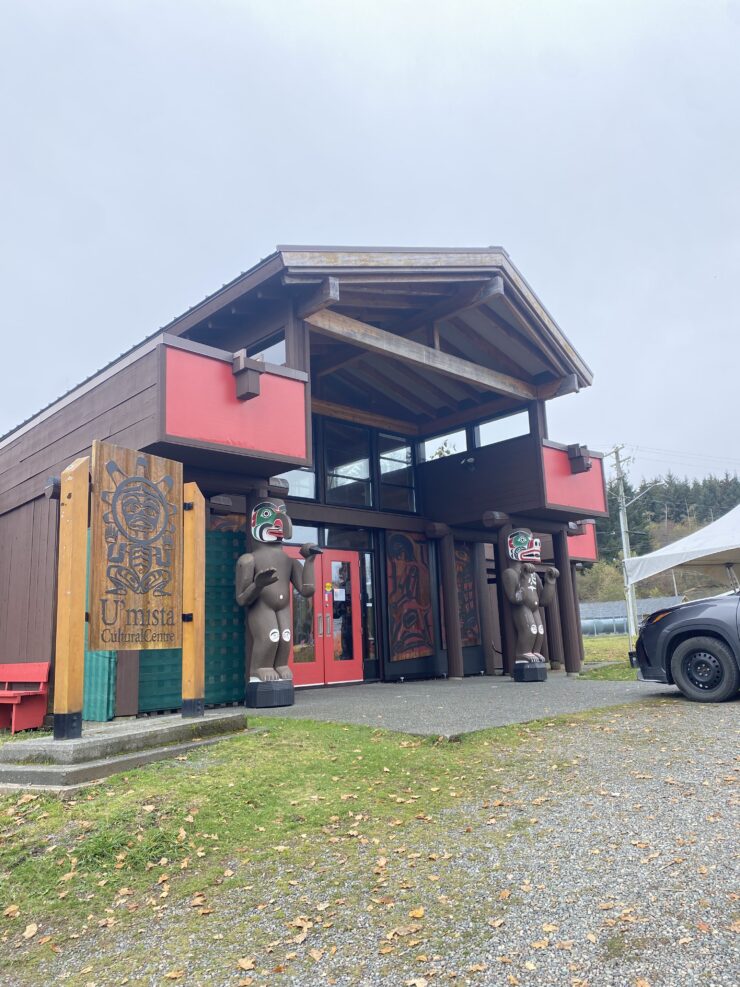
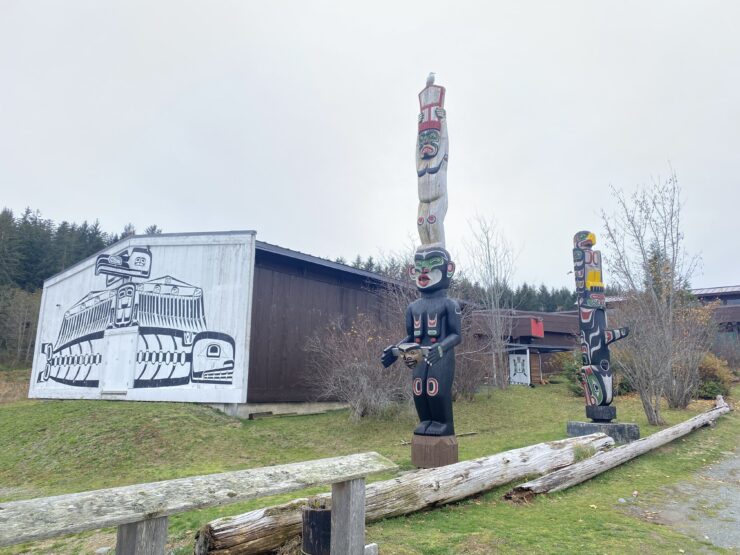
Most of the confiscated pieces eventually did come home. It took determined advocacy, was led for decades by Gloria Cranmer Webster, Dan Cranmer’s own daughter, and in 1980 the U’mista Cultural Centre opened in Alert Bay to house them. The name means the following: historically, when someone taken captive finally returned home, it was said they had experienced u’mista: the return of something important. The elders who named the centre were making a deliberate claim; that this wasn’t a donation or a transfer of property, but the same kind of homecoming (Webster 1990).
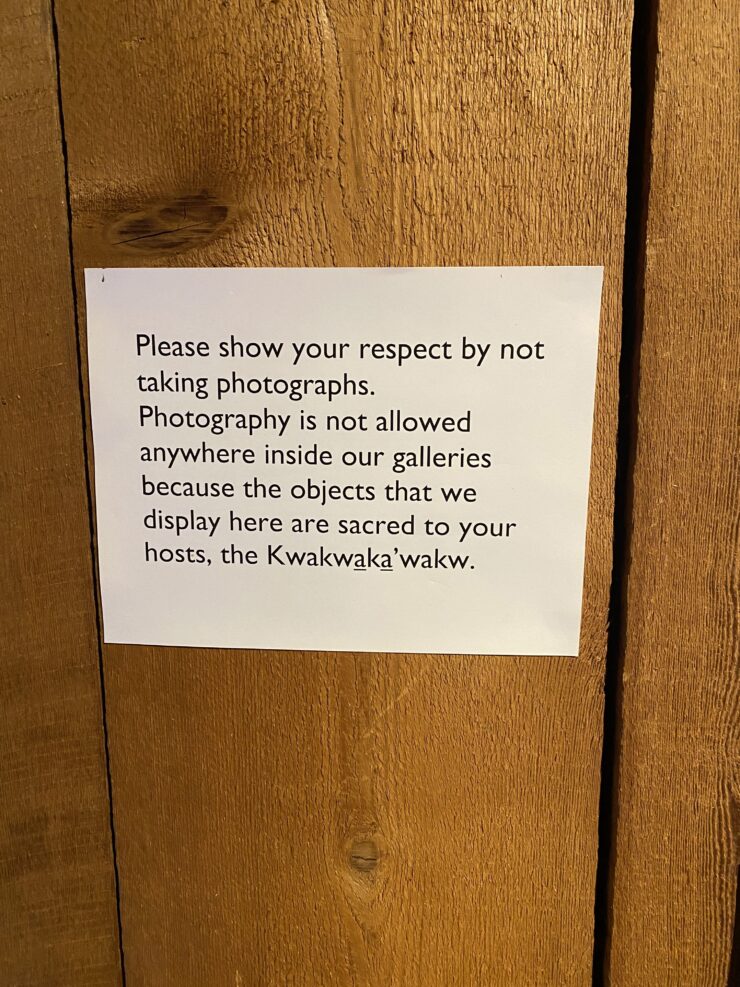
Walking into the building, this claim is visible immediately. Members of the Kwakwaka’wakw First Nation get in free; a boy at the front counter explained it to me simply: “Because all this stuff is theirs, you know.” The Executive Director, legally the owner of the collection, describes her own institution as a caretaker rather than an owner. And the heart of the building, the potlatch gallery, is built to resemble a bighouse: wood floors, wood pillars, high ceilings, and almost nothing behind glass. The masks face inward, toward the centre of the room, displayed openly. People come in and sing to them.
That open display isn’t an aesthetic choice. In Kwakwaka’wakw practice, a mask that has been danced is considered awake, and needs to be put back to sleep. It needs to wrapped, covered, treated with the same care you’d give something alive, because it is understood to carry a spirit that can act on its own.(Brown and Cousins 2001; Caroll 2017). A community member described it to me over coffee, only half joking: hang the wrong mask on your wall and “it will haunt the hell outta you for the rest of your life.” That belief, that these are not objects, but beings with agency, is what makes open display in the gallery feel less like a compromise on conservation standards and more like the whole point of bringing the collection home at all. They are meant to be interacted with.
The mask that came back but never really arrived
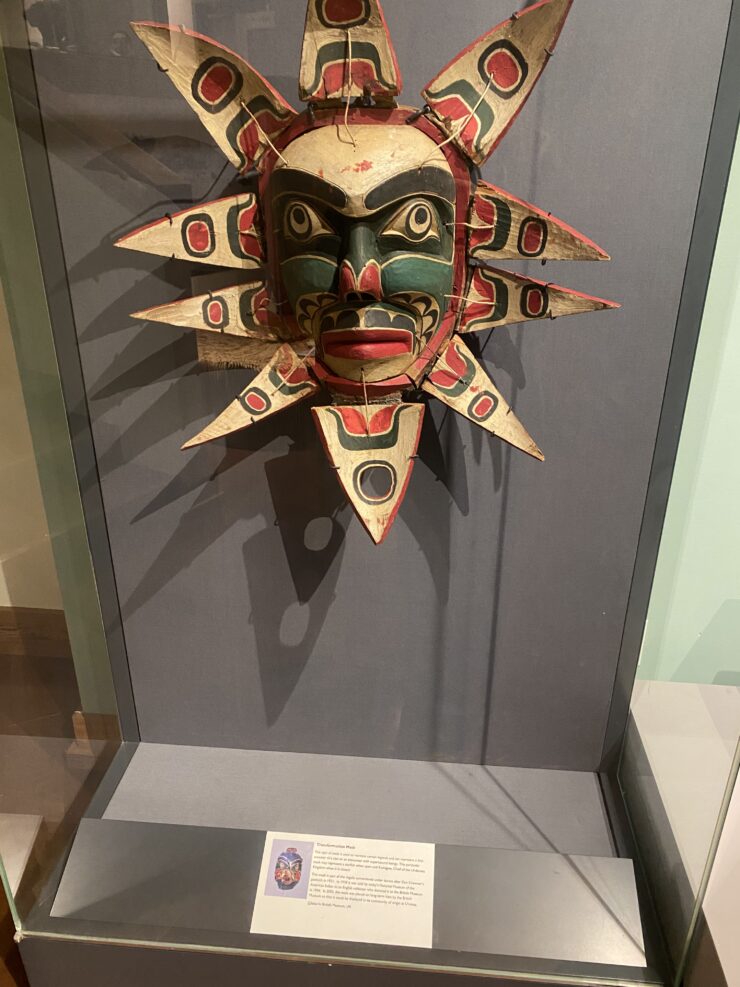
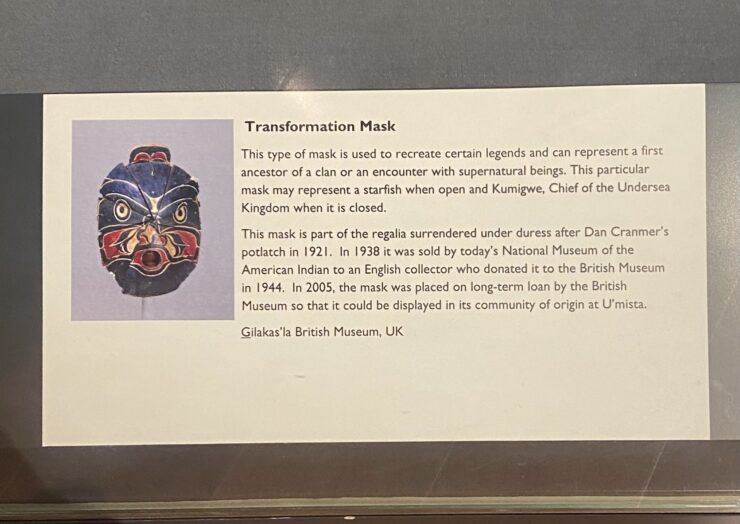
Not everything in the U’mista collection sits in that gallery, though. One of the most extraordinary pieces, a mechanical transformation mask that opens to reveal K’umugwe’, Chief of the Undersea Kingdom, is displayed alone, in a different room, sealed inside a glass case.
Its journey was different. Sold on from collector to collector, it ended up at the British Museum in 1944. It took a member of the Kwakwaka’wakw community recognising it in an old confiscation photograph, and then years of correspondence and advocacy from U’mista’s leadership, before the mask was finally brought back to Alert Bay in 2005. But under British law, the British Museum could not fully return it. What came back was a long-term loan. The Museum still owns it. A conservator still travels to check on its condition. It still needs to be protected from the same dust and light and handling that the rest of the collection has been deliberately freed from (Sanborn 2009).
So the mask sits behind glass, not to be interacted with without glass protecting it from decay, some meters away from pieces that were once seized right alongside it, now separated by a legal technicality some (non-indigenous) visitors might not notice. I kept coming back to that case during my fieldwork, because it makes visible something that’s very easy to miss when restitution is framed as a single, completed event: ownership is not just a label. As Khadija Caroll writes of museum vitrines more broadly, the glass creates “an alienation of cognition from identification and embodiment”, it offers the illusion of access while enforcing a real separation (Caroll 2017, 24). It doesn’t just protect the mask. It also keeps it, in a quiet but very real sense, still on the museum’s terms.
Why “giving it back” isn’t the finish line
This is the argument at the centre of my thesis: decolonizing restitution has to mean more than the physical handover of objects. The dominant heritage framework we inherited from Western museums tends to split culture into two boxes: 1. tangible (the mask, the mask, the physical stuff) and 2. intangible (the songs, the stories, the right to wear it). And then quietly prioritises preserving the first over living out the second (Meyer and van de Port 2018). That split makes sense if you think an object’s meaning lives in its material form (Clavir 2002). It makes much less sense if you think, as many Kwakwaka’wakw people I spoke with do, that meaning lives in use: in being danced, sung to, eventually worn out or even ceremonially burned and replaced.
Under that lens, some of what looks like generous restitution can still carry colonial assumptions in its fine print: who is allowed to decide how something is displayed, whether it can be touched, whether “protecting” it is even the right goal. Objects like the potlatch pieces don’t just sit still once they’re returned, either: they keep moving through new meanings and relationships, the way Arjun Appadurai describes things gaining and losing significance as they circulate (Appadurai 1986). The U’mista Cultural Centre has spent forty years quietly renegotiating almost all of that. By rejecting the word “museum,” building a gallery shaped like a bighouse instead of a gallery shaped like a gallery, treating legal ownership as something closer to guardianship. The transformation mask is the one piece where that renegotiation hit a wall it couldn’t get past.
Why I’m not done
Partway through my fieldwork, a conversation I’d planned around the potlatch collection turned into something else entirely. The person I was talking to wanted to talk about reconciliation. Not as a policy word, but as something personal: the pain he still carries, the wrongs that were never really acknowledged, what it would actually take for things to be made right. He made it clear, without needing to say it in so many words, that returning objects is only ever a piece of that. You can hand a mask back and still leave the deeper wound untouched.
That conversation has stayed with me longer than almost anything else from the fieldwork, and it’s the reason I consider the thesis finished but not the research itself: it closed a chapter, not the subject. Reconciliation, as the people who are actually living it described it to me, goes a long way past the return of objects. It touches land, language, recognition, the right to define your own institutions rather than negotiate around someone else’s. As far as I’m concerned, the research doesn’t stop here. I want to keep pulling on that thread, to understand restitution not as an endpoint museums can check off, but as one small, necessary piece of the much larger, ongoing work of reconciliation.
Sources
All quotes and observations not otherwise atrributed are drawn from my own fieldwork on Vancouver Island and in Alert Bay, conducted for:
Harmsen, Anne. 2024. Decolonizing Restitution: The Potlatch Collection at the U’mista Cultural Centre. RMA Thesis, Religious Studies, Utrecht University.
Appadurai, Arjun, ed. 1986. The Social Life of Things: Commodities in Cultural Perspective. Cambridge: Cambridge University Press.
Brown, Joseph Epes, and Emily Cousins. 2001. Teaching Spirits: Understanding Native American Religious Traditions. Oxford: Oxford University Press.
Caroll, Khadija von Zinnenburg. 2017. “The Inbetweenness of the Vitrine: Three Parerga of a Feather Headdress.” In The Inbetweenness of Things: Materializing Mediation and Movement between Worlds, edited by Paul Basu, 23–36. London: Bloomsbury Academic.
Clavir, Miriam. 2002. Preserving What Is Valued: Museums, Conservation, and First Nations. Vancouver: University of British Columbia Press.
Cole, Douglas, and Ira Chaikin. 1990. An Iron Hand Upon the People: The Law Against the Potlatch on the Northwest Coast. Vancouver/Seattle: Douglas & McIntyre / University of Washington Press.
Meyer, Birgit, and Mattijs van de Port, eds. 2018. Sense and Essence: Heritage and the Cultural Production of the Real. New York: Berghahn Books.
Sanborn, Andrea. 2009. “The Reunification of the Kwakwaka’wakw Mask with its Cultural Soul.” Museum International 61 (1–2): 81–86.
Webster, Gloria Cranmer. 1990. “The U’mista Cultural Centre.” The Massachusetts Review 31 (1/2): 132–143.
Webster, Gloria Cranmer. 1995. “The Potlatch Collection Repatriation.” University of British Columbia Law Review, Material Culture In Flux theme issue: 137–141.