



Rashida Alhassan Adum-Atta
Food and Interreligious Coexistence in Madina studies the modalities in which people coexist with regard to food matters in multi-ethnic and multi-religious Madina, a suburb of Ghana’s capital city Accra. Situating food within the context of everyday encounters of people in spaces such as market, home, street, chop bar/restaurant, this dissertation is based on extensive ethnographic research on how everyday associations with food shape relations and demarcate boundaries between Muslims, Christians and traditionalists. Its central theme are the religious negotiations and entanglements that do – or do not – occur in everyday practices of eating together and sharing and not sharing of food.
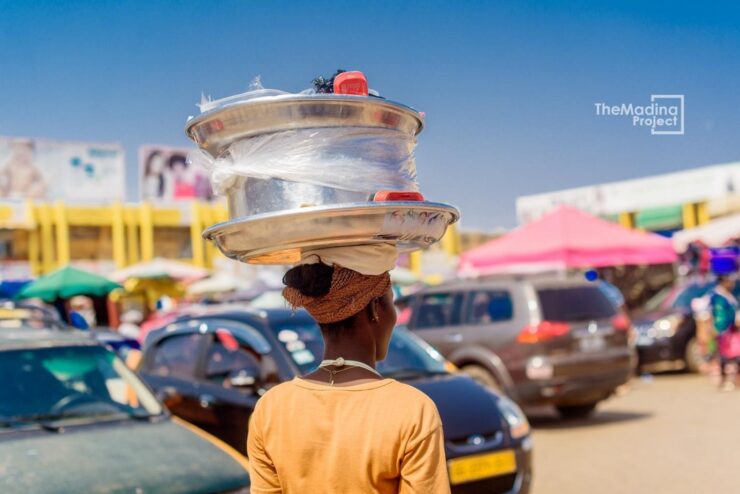
Examining how religious identities are negotiated in Madina’s multi-religious environments, this dissertation focuses on everyday practices of eating, sharing, and coexisting in plural neighbourhoods, and the ensuing negotiations. The main question this study seeks to answer is: How do food and everyday food choices and exchanges shape the process(es) of religious identity formation and of interreligious encounters between Muslims, Christians and traditionalists in Madina Zongo? To answer this question, I address the following sub-questions:
- How do negotiations of maintaining one’s religious identity in a multi-religious environment occur through everyday food choices on the household level?
- How does food function as an interreligious converging and diverging point during religious festivals?
- How do Muslims, Christians, and traditionalists negotiate their religious identities through discourses attached to food and food sharing, and which affects are entailed?
- What is the impact of food consumption (vendors) and market activities on the interreligious relations?
- In which ways are some religiously tabooed foods such as pork and alcohol negotiated?
Methodological Focus
Grounded in ethnographic research over a period of five years, this study shows that food is a useful instrument for forging solidarity and alliance, identity, and power, as well as for demarcating lines and boundaries. Throughout this dissertation, I draw on both my primary ethnographic data, and on secondary literature. A focus on food is of great help to understand the role of religion in shaping embodied experiences of interreligious social relations as well as the establishment and maintenance of social networks. The thesis demonstrates that food offers an essential language, one that functions differently at various levels. It is a system of communication that brings and bonds people together. This dissertation covers the everyday uses of food in everyday lived experiences of my interlocutors.
In focusing on ways in which people coexist by negotiating food habits in a multi-ethnic and multi-religious neighbourhood, I paid much attention to the everyday lived experiences of my interlocutors as well as to my personal experiences. This was helpful in unfolding abstract opinions that were not well illustrated or exemplified. The mechanism was useful to gain a deep appreciation of the richness of doing ethnography with regard to the realities of everyday life. Based on fieldwork, there is a wider perspective for experiencing the realities of everyday food life practically. Conducting research, I paid heed to participant observations and narratives. I endeavour to make clear the distinctions between my opinions and my interlocutors’ arguments, ensuring that I situate my context alongside my interlocutors’ voices.
Employing auto-ethnography as an anthropological approach helped to delve deep into field research, making visible perspectives that conventionally remain unseen. As a Muslim researcher, this technique offered a deeper understanding of dealing with so-called haram ingredients. This was helpful in unfolding abstract opinions that were not well illustrated or exemplified.
Auto-ethnography as an anthropological approach allowed me to delve deep into field research, making audible ordinarily mute perspectives. I spent much of my time engaging with a number of my interlocutors, reflecting on their food matters. For instance, I spent my evenings at pubs in Madina; these places are locations of convivial activities in somewhat close and narrow spaces. These spaces primarily sold alcoholic beverages. As a Muslim, I had to negotiate invitations to alcoholic drinks, so I needed to dress to suit this space. Specifically, jeans and a top were convenient attires for these spaces.
Focus group discussions, participant observation, interviews, casual chats and food conversations, newspaper reviews, and social media and photographs were helpful dimensions of my ethnographic work. I made use of photographs during fieldwork, thus adding additional focus and attention to moments when I could not visually capture everything around me.
Research Sites
This research sought to cover food uses and activities in the multi-religious and multi-ethnic neighbourhood of Madina Zongo. Geographically, the study focused on, but was not limited to, Madina Zongo
The Market
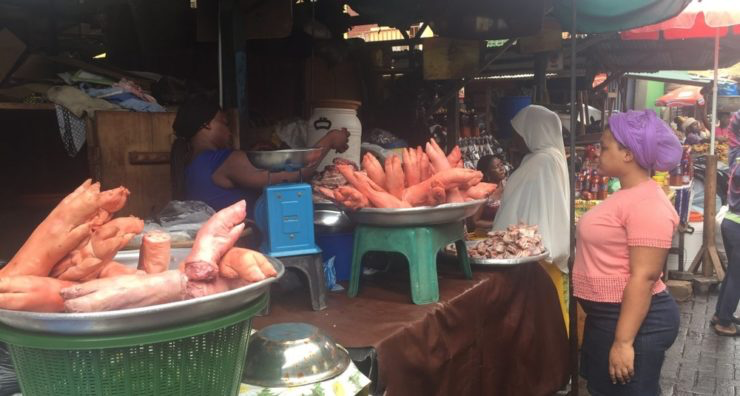
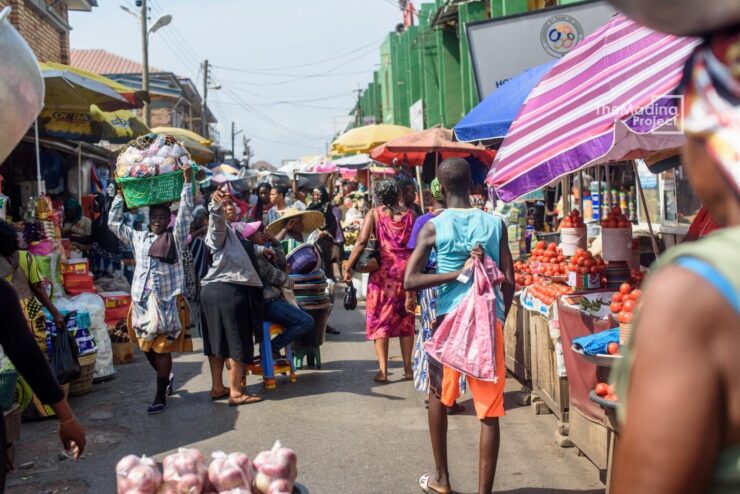
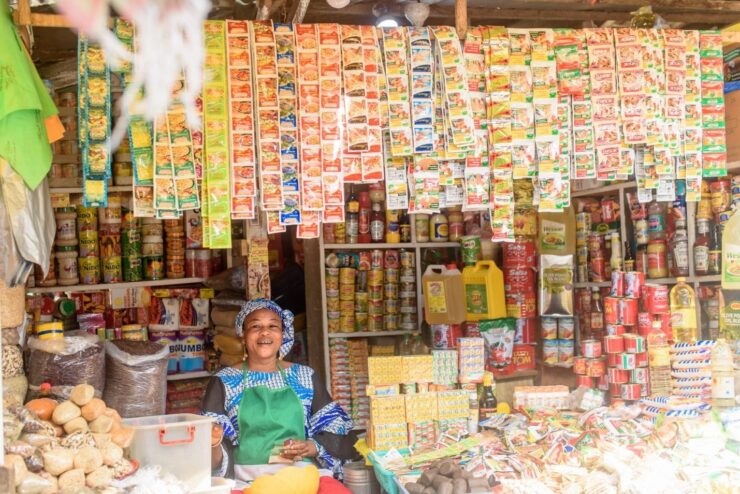
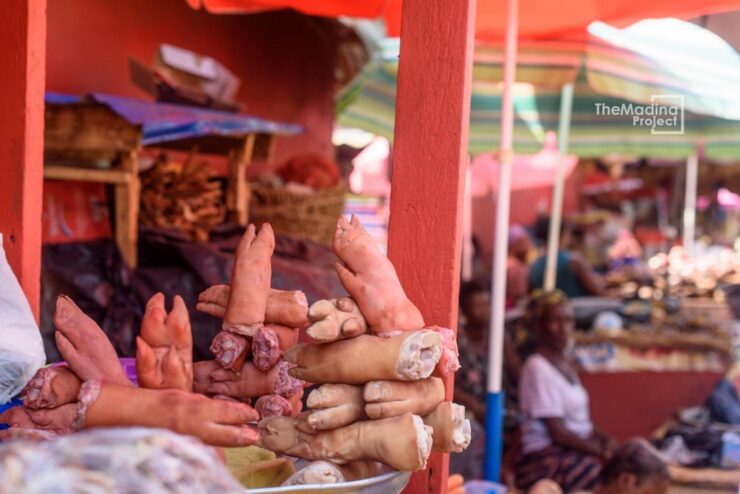
The market serves as a site for the meeting and interaction of diverse people and objects. The market often gives us not only insights into the cultures its members belong to, but also into the foods and favourites of outsiders of that culture. Christian, Muslim, and traditionalist believers share in Madina Market, albeit temporarily, a common space in which they negotiate how to maintain their religious identity in relation to the presence of religious others. In the market, I paid much attention to places such as the butcher shop, which produces halal meat for multi-religious Madina, as well as to the section in which pig feet imported from Europe, which are haram for Muslims, are sold. The interactions at the market brought to the fore the inclusive and exclusive ways in which humans and food ingredients coexist.
Food Vendors/ Restaurants and Pubs
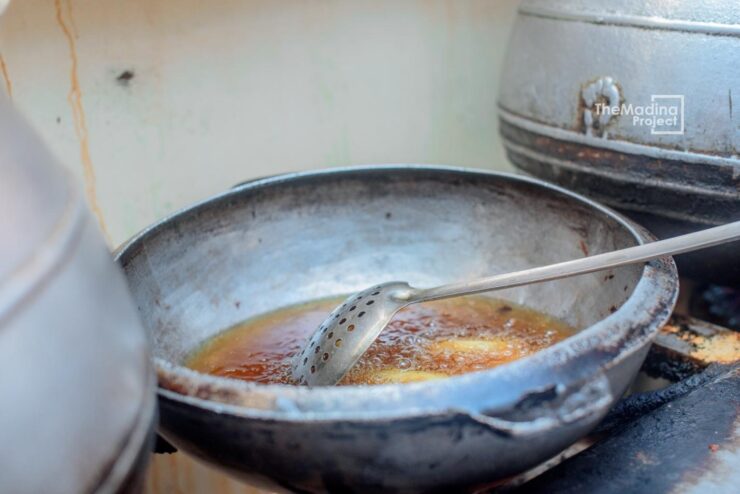
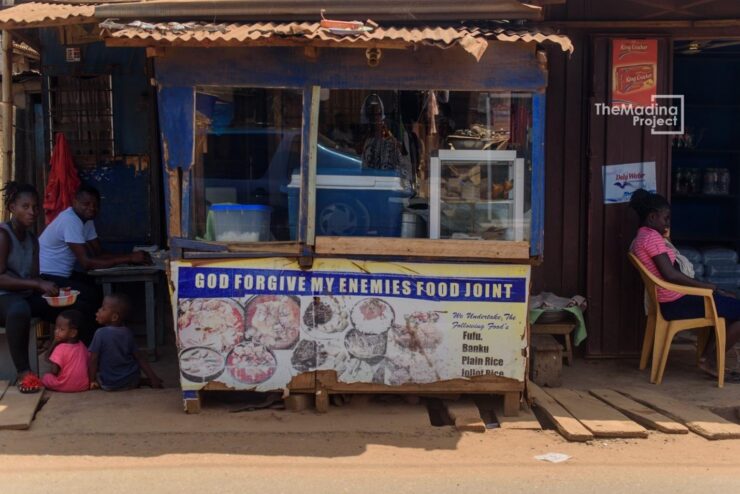
Food vendors, restaurants, and pubs are nodes that connect people to food. One cannot fully appreciate food identity without first engaging with the nodes of food. Food vendors are significantly noticeable at Madina Zongo. They shape the food spaces by constantly serving their clients to satisfy their appetites. Vendors of cultural foods connect people not just with food but with a culinary identity from home. Madina is known to house people from different ethnic groups; therefore, these groups of people also experience food connections and a sense of belonging, reaffirming their identity through food. For instance, chop bars are known for their local cuisines such as fufu, banku, and rice balls, and create connection through smells.
Family Spaces
The ethnographic evidence shows that there are different ways in which families bond through food, and this work shows ways in which family members negotiate menus and select food ingredients.
Servicing Coexistence through food
This study explores how people eat in Madina Zongo, how families and individuals make food choices, and establishes the meanings of food amongst various classes. The work focuses on how Christians, Muslims and to a lesser extent practitioners of African traditional religions make choices in cooking, sharing menus and eating. It documents how my interlocutors and I stepped into Madina’s food market, finding trust to be one of many qualities that help in their choices. In doing so, the research highlights the importance of the food market, emphasizing the importance of certain food ingredients and showing how some are associated with religion, ethnicity and gender.
Food as a language is used to express belongingness and bonding between husband and wife or wives, between parents and children, as well as vendors and clients. Narratives from the field show that food also has the potential to spark tension between co-wives, between families in a compound, and between husband and wives. Acceptance of food is used as an instrument of power, either to reinforce ‘good’ behaviour or to discipline those who do not conform to certain expectations. In light of this, the research looks at how authority is upheld in the distribution of food domestically with references to bases (male dominated circles) and reflection on gendered roles. The work highlights the various roles of members of the family, especially women as primary care givers who provide food for the family.
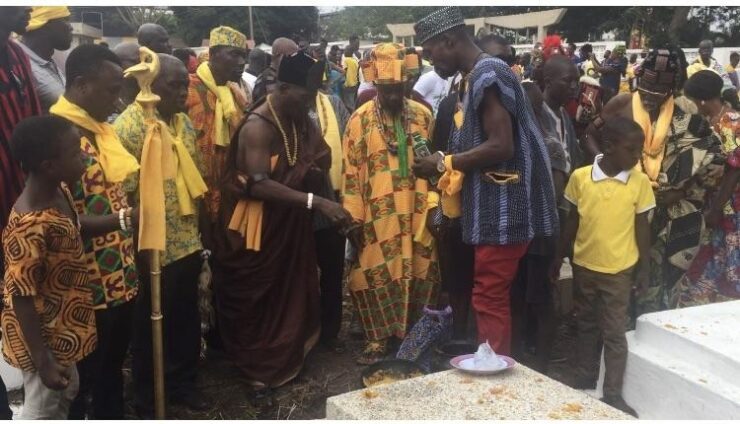
Second, the research examines religious festivals as moments of food exchanges and compares who gives and who receives what and how during festivals such as the Ga festival Hɔmɔwɔ, the two Eids, and Christmas. It illustrates that these festivals do not only create cohesion within the groups who are in charge and their participants, but also involve the inclusion of religious others through exchanges of food. Importantly, religious adherents have a sense of obligation to share and accept but also feel inclined to not accept certain gifts due to fears and a stronger emphasis on religious doctrines. This demonstrates a will to maintain exchange amongst people of different religious backgrounds even though fears of pollution may rise as religious identity has become more pronounced.
Third, this research shows how food and sharing has always been a sensitive matter by throwing light on matters of purification, contamination and wholesomeness. This work examines halal as a moral issue, proving that trust matters in the purchase and consumption of meat from halal butcher shops. I explore the trajectory of slaughter performed largely by Muslims, a minority group in Ghana, and show how it has become an uncontested profession for Muslims. The butcher shop is an established space for wholesome meat. The research discusses the meaning and awareness of halal literacy, proving that it has increased. This, in turn, has increased the need for halal certification, pointing to a renewed importance of eating halal.
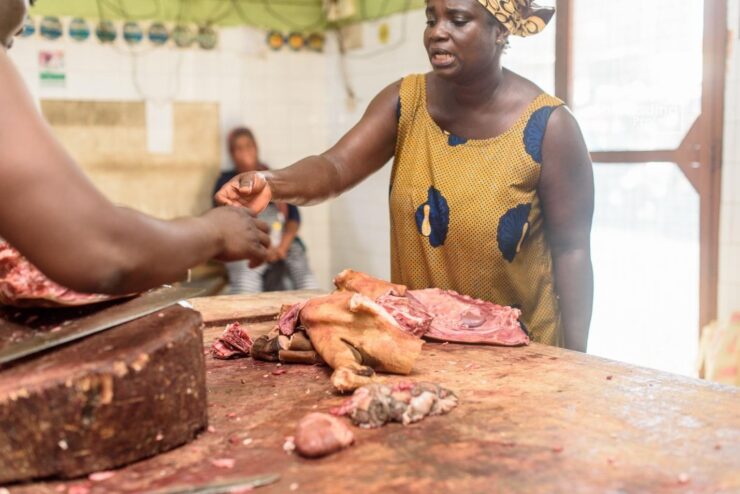
Fourth, the research focuses on pig trotter which is subject to a religious taboo, a disgusting ingredient in the eyes of Muslims, but at the same time a tasty food to others. Hence the presence of trotter is prone to cause tensions as Madina Market is located in a predominantly Muslim area. As pig feet are not locally produced, this work pays attention to the historical connection of trotters to Ghana, as well as to global entanglements associated with this ingredient that is taken as tasty, a religious taboo (primarily observed by Muslims) and disgustful.
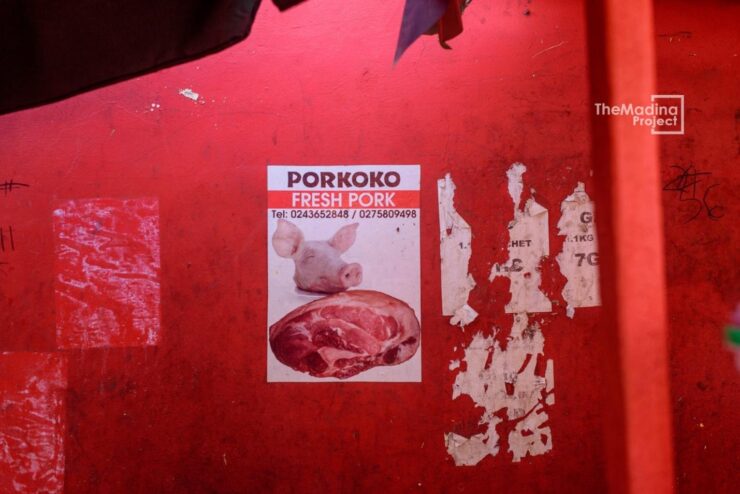
Considered haram and unclean by Muslims, trotter triggers religious sensibilities and evokes strong responses. The work interrogates the ways and manners in which religious practitioners who visit and use the Madina market react to the presence of the pig feet. Focusing on the conspicuous presence of pig trotters, this research argues that religious practitioners are aware that the presence of this ingredient could potentially create tension, and therefore observe techniques of distancing and inattention.
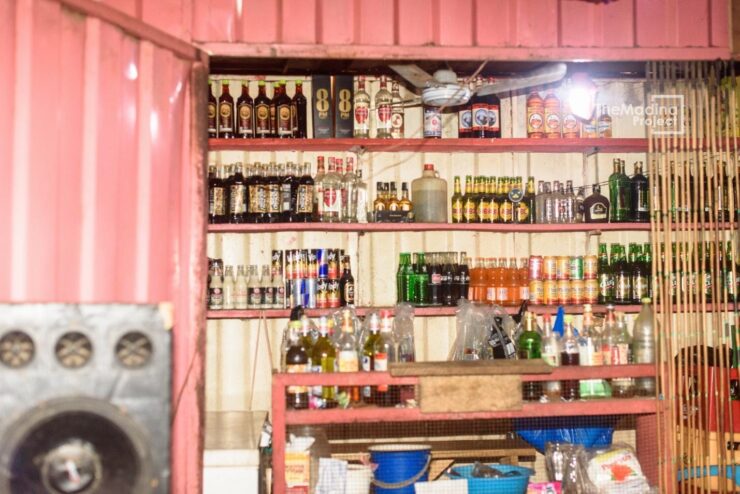
Lastly, this work addresses another item classified as haram by Muslims and contested by Pentecostal Christians. But unlike pork, Muslims respond to alcohol differently, even though both are haram. Whereas pork elicits disgust and avoidance among some Muslims, the presence of alcohol and its consumption is condoned. On multiple levels, the haram-ness of alcohol is negotiated differently from the haram-ness of pork in Madina amongst Muslims. The research shows that, on the one hand, alcohol is for sale everywhere, while, on the other hand, many inhabitants question the public presence of alcohol sale and consumption. The work discusses how people negotiate their participation in a world such as Madina, where religion is omnipresent, yet which is filled with things that are not in line with the basic moral imperatives imbued in the inhabitants’ religions. This research acknowledges that the permissibility of alcohol is also an issue that divides Christians, in that some Christians consider alcohol consumption permissible, whereas others consider it prohibited. This thesis argues that alcohol offers an interesting angle for the study of negotiations of religious differences and issues of morality. This work explores how drinking practices are socially constructed, whereby negotiations of identity and religion matter.
Conclusion
Religious matters remain at the core of everyday life in Madina, and food as a daily need is a productive entry point to study modes of coexistence. Taken as a whole, this dissertation shows that the status of Madina as a migrant community, as well as a multi-religious and muti-ethnic environment, allows many people to negotiate and tolerate a plethora of possibilities. Ideally, they are open to new social order, allowing social interactions through food and drinks. Co-existence in a plural neighbourhood such as Madina means that no one can impose his/her religious views on the setting.