



Daniel Ellwanger
Spotlight on Images
At the entrance to the Rosary Basilica in Lourdes, one of the large church buildings in the famous Catholic pilgrimage site in the south of France, large mosaics adorn the façade of the building. The mosaics illustrate the luminous mysteries of the Rosary, the mysteries of light, a sequence of Marian meditations, introduced during the pontificate of Pope John Paul II. They were presented to public on December 8, 2007, on the Feast of the Immaculate Conception on occasion of the 150th jubilee of the Marian apparitions of Lourdes. Inspired by Byzantine style, the mosaics cover the entire front façade of the basilica and exhibit a vibrant display of color. They play a key role in Lourdes’ aesthetics of illumination during the evening Marian torchlight procession. These pieces were designed by Marko Rupnik, a Jesuit priest and artist who was once celebrated for his talent in transforming theological ideas and biblical motifs into radiant religious art.
A significant number of sacred Catholic edifices worldwide are adorned with Rupnik’s mosaics. However, in recent times, the mosaic pieces have become unbearable to many. Since 2022, Rupnik has been confronted with substantial allegations of sexual and spiritual abuse of women who collaborated with him in religious communities and assisted him in his work. (1) In light of these allegations, Rupnik’s artworks have turned into contested presences. The pieces, which were initially developed with the catechetical objective of inviting prayer at sacred sites and were commissioned by Catholic institutions, have now elicited criticism, anguish, and the potential for trauma among church members who have suffered from and survived clerical abuse. Rupnik has been expelled from the Jesuit order and removed from his religious offices. Upon the dissemination of allegations against Rupnik, a significant number of both laypeople and clergy members advocated for the removal of his mosaics from the basilica in Lourdes. Yet the fate of the mosaics in Lourdes remains unresolved, giving rise to controversy.
In Lourdes, a site that receives up to four million pilgrims annually, this controversy has given rise to a particular dissonance. The shrine, distinguished by the special attention and care it grants to sick and ailing pilgrims, is now compelled to address the violations inflicted by clerics and priests. In July 2024, Bishop of Tarbes and Lourdes Jean-Marc Micas articulated his conviction that the mosaics must eventually be removed from the basilica’s façade. However, following consultations with survivors of abuse and experts, he decided to retain the mosaics in place but to cease their distinct illumination during the torchlight processions that take place in Lourdes each night and are a prominent feature of the shrine. Months later, in March 2025, he issued a directive for the concealment of those mosaics on the basilica’s front door, while the elements positioned on either side of the basilica’s doors and on the upper façade were to remain uncovered and visible. This decision not only reflects but materializes a discrepancy between recognition and concealment, between acknowledging the suffering inflicted on believers and protecting sacred aesthetics.
Materiality and the Affective Landscape in Lourdes
Between fall 2021 and summer 2024 I conducted several research trips to the Lourdes shrine. Taking on various participant roles in the field, I accompanied groups organized by church-affiliated pilgrimage organizers but also participated in the formation process of lay helpers at Lourdes. My aim was to understand how pilgrims approach the shrine with their own expectations and desires, and how they relate their stories of healing to Catholic rituals performed by pilgrims, clergy and lay helpers on site. Although I had already finished most of my fieldwork by the time the allegations against Rupnik were disseminated, some of the insights I gained during my research may still be valuable in the context of this essay. A significant number my informants characterized the architectural design and the atmosphere of the sanctuary – what they saw and felt – as welcoming and uplifting. To understand the entanglement of place, vision, and the body in Lourdes more profoundly, the following statement of a pilgrim I interviewed in May 2021 may serve as an example. When asked to describe the atmosphere at the sanctuary, she provided the following description: “On every corner something wonderful is painted! So, you really believe that on every corner somebody steps out of the image and consoles you somehow!” (2) The visceral and metaphorical language is crucial in this context, as it directs our attention toward the lived experiences of pilgrims. In the account of my interview partner, the images are animated and brought to life. The built environment, including architecture and images, morph into an experience of religious presence, inhabitable by pilgrims through offering meaning and comfort for them. Matter and images transcend their role as a mere backdrop, emerging as an active medium that is meticulously crafted to foster an atmosphere of hope and healing within the confines of the shrine.
In the perception of architecture and imagery that my informant vividly described, the basilica with its mosaics occupies a central place in the sanctuary. As pilgrims and visitors traverse the space, it becomes virtually impossible to avoid its presence or bypass the basilica, whose mosaics, designed to interact with light, draw the gaze of onlookers with their colorful and luminous surfaces. The mosaics absorb and refract light, creating a visual dynamic that mirrors the theological narrative they depict, emphasizing luminosity and illumination as central themes in the Rosary. As sociologist Torsten Cress has demonstrated, the performance of the nightly torchlight procession at Lourdes adds a “dramaturgy of salvation” to the visual interaction through collective movement and the coordinated illumination of images and statues. (3) The employment of this collective illumination technique yields the sculpting of the mosaics on the façade out of darkness, thereby conferring upon them a prominent and visible role during the evening procession. The movement of the procession towards the basilica, in both a symbolic and a material sense, signifies the entry into a space that is imbued with divine radiance.

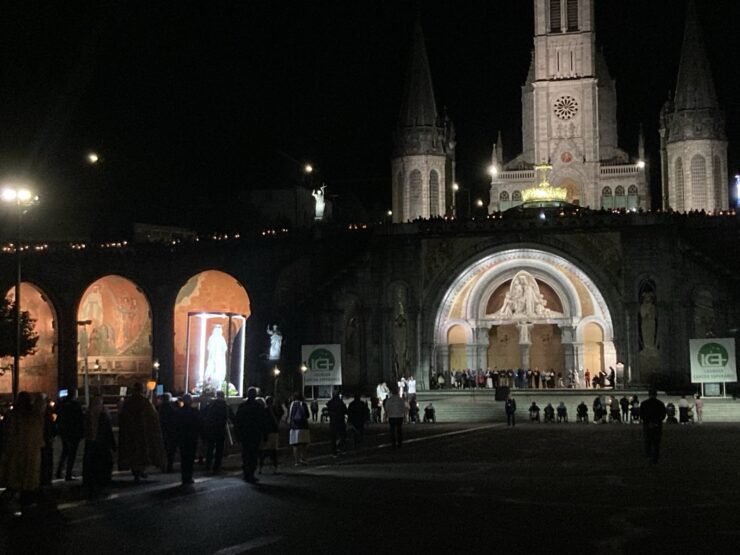
However, this same visual regime now appears in stark contrast to the severity of the allegations leveled against the artist. For survivors of clerical abuse and those who share in their affliction, these mosaics no longer embody the mysteries of illuminated faith but instead they exemplify the enduring presence of harm within the Church itself. Upon entering the sanctuary, survivors of abuse encounter not only with biblical images but also by the presence of an artwork that, in light of the creator’s abusive actions, may be perceived as offensive—not only by victims, but also by pilgrims who are aware of this context. Affect theory is a useful framework to capture this dimension of “feeling material culture”. (4) The mosaics operate as affective surfaces as they gather and transmit emotion. For pilgrims who come to Lourdes seeking consolation and solace, these images can radiate serenity and visually introduce them to mysteries of the Catholic faith. However, for victims and those who share in their anguish, the images can emit feelings of repulsion. The sensory configuration of the shrine thus transforms into a moral topography wherein experiences of divine grace and violation coalesce. When the Bishop of Lourdes decided to refrain from illuminating the mosaics during the nightly procession, he intervened precisely in this affective economy. The act of obscuring light is a deliberate effort to diminish the radiance of the mosaics and reduce the profound emotional impact that the mosaics can now evoke.
Aesthetics of Concealment as Visual Strategy
The subsequent partial covering of the mosaics on the basilica’s doors in March 2025, as depicted in the photograph below, further substantiates this rationale for affective management. The authorities’ decision to restrict their visibility on the doors, while maintaining the visibility of the upper mosaics, materially confines the emotional weight to the threshold. The act of entering the Rosary Basilica requires traversing a space marked by quiet tension.
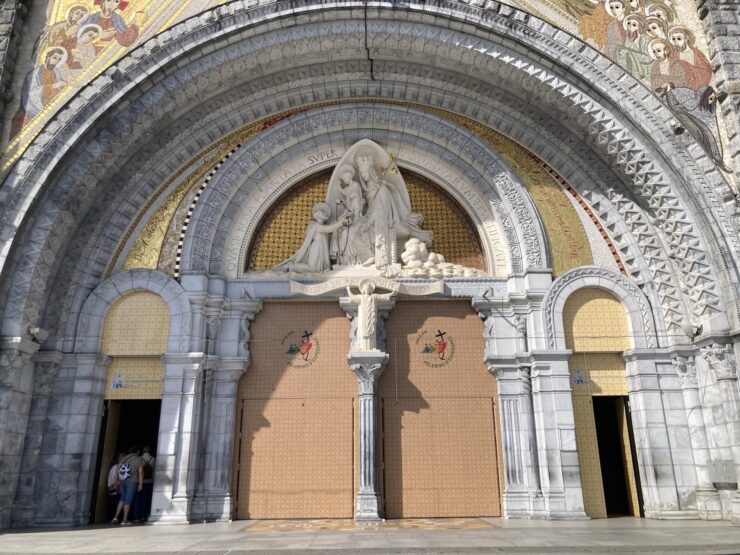
This arrangement transforms the basilica’s façade into a layered zone of conflict: the visible promise of transcendence and divine presence clashes materially and symbolically with the veiling as a reminder of abuse and suffering. The partial veiling of the mosaics is a gesture that acknowledges inflicted trauma yet stops short of a more radical corroboration of victim visibility in contemporary Catholicism, a rationale that Lourdes’ bishop, at least rhetorically, presented as a pressing issue.
In Catholicism, there exists a long tradition of veiling and covering sacred images during Lent, shielding tabernacles with curtains or wrapping relics. Veiling in these contexts signifies both reverence and restraint. Concerning the mosaics in question in Lourdes, however, the veiling reverses this logic. The Church thus retools its visual repertoire to manage its own moral exposure which believers confront it with. In the eyes of many, to leave a large proportion of the mosaics untouched means to continue centering the artist’s presence at the sanctuary. The façade now stages quite literally the institution’s irresoluteness between protecting abuser and those got harmed.
Layered Visibility
At this stage, the inquiry transcends mere aesthetic or affective considerations, delving into ethical and discursive domains. What implications might such gestures have for the Church? The veiling’s ambivalent nature is characterized by its simultaneous capacity to obscure and convey a message, thereby creating a multifaceted and enigmatic effect. In the context of Lourdes, the decision to conceal the mosaics adorning the doors while maintaining the visibility of the upper and lateral façades stratifies the viewer’s gaze. The partial veiling of the Rupnik mosaics modifies not only the architectural surface, but also the manner in which vision operates within the shrine. Pilgrims now encounter a façade of uneven visibility. As David Morgan (5) has demonstrated, the act of seeing in religious contexts is not an abstract phenomenon but rather an embodied and social practice. The act of looking is intricately intertwined with bodily, emotional, and collective participation in a network of meanings and hierarchies. Vision can be conceptualized as a medium of relation, binding the beholder to both the perceived material form and the institutions that aim to regulate perception. The visibility of a material form can thus serve as an indicator of claims and interests. The Church’s decisions regarding what is permitted to remain visible and what is concealed inherently carry profound symbolic significance; therefore, they do not remain neutral. These decisions influence how believers occupy a sacred ecology and how they comprehend their own role within it.
Victims and survivors of clerical abuse have challenged this established order by insisting on their own visibility. They have argued that the suffering they endured, as well as the structures that enabled such abuse, must be acknowledged by the Church. The façade thus becomes a field of negotiation where material aesthetics and moral recognition intertwine. The politics of visibility and vision enacted here further extend beyond the basilica. The act of partly concealing the mosaics may offer a sense of solace to some, yet it simultaneously highlights the manner in which authority is exercised through the medium of vision. By controlling what adherents are permitted to observe, the institution persists in influencing the very concepts of healing and accountability within its sacred architecture.
The controversy surrounding the Rupnik mosaics reveals the intricate interplay between light and concealment, and how these are entangled with the power dynamics of contemporary Catholicism. In Lourdes, a site defined by its promise of illumination and healing, the decision to obscure and partially veil the basilica’s façade marks a significant shift in how local authorities manage visibility. The distinction between what is revealed and what remains concealed transcends mere aesthetic decisions. It determines whose experiences are acknowledged within the sanctuary. The mosaics have ceased to function as devotional images in the traditional sense; they have become a palimpsest of emotion, where faith, anguish, and conflict are inscribed into the materiality of the sanctuary. The interplay of shadow and light on the façade mirrors the Church’s broader struggle to confront its own shortcomings while maintaining control over the gaze of believers, transforming the sanctuary into a contested field of vision. Ultimately, the mosaics illustrate that Catholic material culture is not a neutral vessel of transcendence, but an arena where the boundaries of visibility, authority, and healing are continously negotiated.
Footnotes
1. https://www.bishop-accountability.org/2025/10/vatican-appoints-judges-to-hear-rupnik-case/.
2. Interview conducted on May 26, 2021. English translation by the author.
3. Torsten Cress, Sakrotope. Studien zur materiellen Dimension religiöser Praktiken (Transcript 2019), 161.
4. Donovan Schaefer, “Feeling material culture: affect, power, sensation,” Material Religion 19, no. 1 (2023): 82-84.
5. David Morgan, The Embodied Eye. Religious Visual Culture and the Social Life of Feeling (University of California Press 2012).
Bio note
Daniel Ellwanger is a Ph.D. candidate in sociology at Leipzig University, where his research focuses on the sociology and anthropology of religion, with particular emphasis on Catholic Christianity, as well as cultural theory. He is an associate member of the Center for Advanced Studies ‘Multiple Secularities’ at Leipzig University and the ‘Centre Marc Bloch’ at Humboldt University in Berlin. He has recently published work on Catholic devotional culture at the Lourdes shrine and the mediation of papal images.