



Utrecht University, 3-4 June 2026
3 June: Janskerkhof 13, 006 (Stijlkamer)
4 June: Drift 23, 012/13 (Tutorkamers)
Convener Birgit Meyer
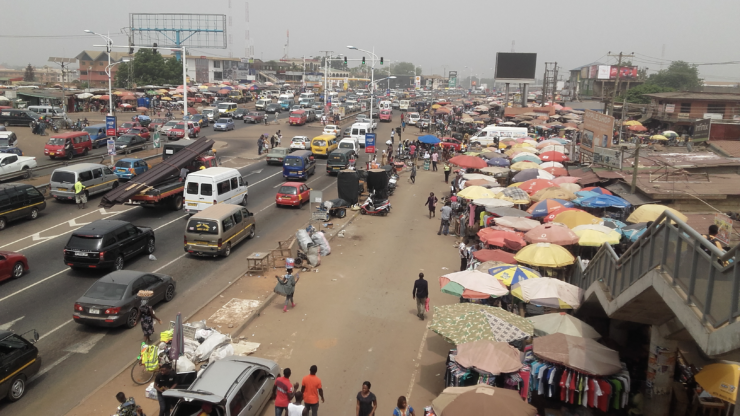
This workshop takes place at the occasion of the defenses of the dissertations by Kauthar Khamis, Martin Luther Darko, Rashida Alhassan Adum-Atta on 2 June 2026 at Leiden University, and Joseph Fiifi Fosu-Ankrah’s online defense in 24 October 2025. The research for the dissertations was conducted within the Madina project (https://religiousmatters.nl/tag/madina-project/ ), which is part of the Religious Matters in an Entangled World research program (www.religiousmatters.nl) led by Birgit Meyer at the Department of Philosophy and Religious Studies, Utrecht University. This research studies the co-existence of Muslims, Christians and “traditionalists” from concrete material angles such as uses of space, beauty, food and health-seeking. It takes a grounded perspective that seeks to highlight how people organize their everyday living in the shared habitat of Madina through practices of co-existing, in which a pragmatic attitude to live and let live, and keep conflicts and tensions manageable, is more central than the emphasis of doctrinal distinctions. At this workshop, the central findings of the Madina project are presented and situated in a broader field of research on co-existence and everyday urban-religious practices in Africa.
3 June 2026
11.00: Welcome
11.05-11.40:
Introduction: Dynamics of Urban-Religious World Making: The Madina Project
Birgit Meyer, UU
As urban spaces are plural by default, the making and imposition of one total world on a city is impossible. Cities are laboratories in which differences and tensions are continuously negotiated, and always in flux. Taking religious plurality as a starting point for research on how religions – literally – “take place” in cities brings into focus the margins of religious traditions, where they rub against, conflict and partly accommodate each other. Doing so calls attention to people’s actual practices of co-existence and the encounters, entanglements and relations ensued by them. In this presentation, I will introduce our collaborative Madina research project on modalities of co-existence of Christians, Muslims and traditionalists in the multi-religious suburb of Madina, Accra. My conceptual and methodological anchor-point to theorize people’s practices of relating, as documented in detail by Joseph Fiifi Fosu-Ankrah, Martin Luzher Darko, Kauthar Khamis and Rashida Alhassan Adum-Atta, is the concept of the interstice (Zwischenraum), which I understand as an in-between space in which connections and relations are shaped.
11.40-12.15
Desire, Precarity, and the Pragmatics of Coexistence: The Male Beard as a Relationally Ambiguous Embodiment in Madina Zongo, Accra
Joseph Fiifi Fosu-Ankrah, Institute of African Studies, University of Ghana
How do urban dwellers read strangers in contexts where bodily signs are saturated with moral, religious, and historical meaning? This article addresses this question by using the male beard as both method and epistemic entry point to interrogate the pragmatics of coexistence in Madina Zongo, Accra. Drawing on ethnographic fieldwork conducted between 2018 and 2019—including observations of everyday interactions and engagements within key nodes of circulation such as the marketplaces and lorry parks—it examines the beard as a relationally ambiguous embodied marker within interreligious encounters. It argues that bodily appearance constitutes a historically and socially charged semiotic field through which urban subjects are read, misread, and classified within shifting regimes of suspicion, admiration, and avoidance.
Situated within Madina’s histories of migration, Islamic settlement, and postcolonial peri-urban expansion, the beard emerges as a socially overdetermined sign shaped by Islamic piety traditions, Pentecostal/Charismatic moral sensibilities, and wider urban anxieties about masculinity, deviance, and spiritual ambiguity. As a result, it is simultaneously valorised by many Muslim interlocutors as a sign of piety and masculinity, while rendered suspect by some Christian actors as a marker of danger, irresponsibility, or concealed intent. In shared spaces such as lorry parks and marketplaces, these competing readings structure encounters that oscillate between recognition and withdrawal, proximity and avoidance.
The article makes two interventions. First, it conceptualises “unfriendly tolerance” as a historically sedimented and active mode of coexistence through which embodied ambiguity is managed rather than resolved. Second, it advances urban precarity as an epistemic condition generated by density, mobility, and anonymity, which destabilises the reading of strangers and amplifies moral suspicion. Interreligious coexistence in Madina, it argues, is sustained not by liberal tolerance but through a pragmatic choreography of uncertainty, cautious discernment, and negotiated distance.
12.15-12.50
Multiple Models for Religious Coexistence in Coastal Kenya
Erik Meinema, UU
Focusing on the coastal region of Kenya, this presentation proposes that living together in religiously diverse settings can be understood in relation to multiple relational models for religious coexistence, through which people understand and regulate religious plurality. These relational models include amongst others (1) forms of political secularism that are promoted by the Kenyan state and civil society organizations, (2) competition between religious groups, and (3) practices in which people draw on multiple religious traditions to meet their everyday physical and spiritual needs. Drawing on extensive ethnographic research, the presentation highlights how everyday practices of living together in coastal Kenya are shaped by multiple models for religious coexistence which often continue to exist side-by-side, each with their own histories, ideals, practices, and places. In this way, it highlights how forms of political secularism relate to other ways of practicing and organizing coexistence that shape the diverse religious field of coastal Kenya.
12.50-13.30 Lunch
13.30-14.05
‘Unto the Lord be the Glory’: Blessings and Curses in Madam-Apprentice Relationship in Madina Beauty Salons
Kauthar Khamis, Islamic University, Accra
In Ghana, apprenticeship is a formal or non-formal process through which skills are acquired across a broad range of professions, including plumbing, carpentry, masonry, dressmaking, and hairdressing. In Madina, young women who seek to attain financial independence frequently enroll as apprentices in beauty salons for a specified period, training under the supervision of an experienced beautician locally referred to as “madam”. Yet, the process of skill acquisition is shaped by a complex relationship between madams and their apprentices, often interpreted in terms of blessings or curses. For instance, beyond the payment of an enrolment fee by apprentices to their madams, an apprentice is also expected to serve her mentor in ways believed to earn her favour upon the completion of training; failing this, the acquired skills are sometimes framed as a curse rather than a blessing. This presentation therefore examines the lived experiences of beauty salon apprentices in Madina, the nature of their relationships with their madams, and what these dynamics reveal for reflections on religious co-existence from a gendered perspective.
14.05-14.40
Endurance, Love Work, and Marital Repair in Accra’s Zongos
Ann Cassiman, KU Leuven
In my presentation I will reflect on the tension that zongo women experience in their efforts to negotiate the (gendered) ethical ideal of ‘endurance’ (sabr in Arabic and hakuri in Hausa) with their desire for love, care, and intimacy. I refer to these negotiations as “love work”: the often-invisible efforts that women make to counter emotional neglect in marriage, particularly in contexts where trusted spaces for advice are scarce. When seeking support, women form loose, discreet circles of female counsellors, among whom kayanmata sellers play a key role. Commonly understood as “marriage sweeteners,” kayanmata products circulate not only as commodities but as entry points into intimate conversations about desire and insecurity.
I interrogate whether kayanmata should be construed as a threat to Islamic virtue and marital stability, as asserted by many men and religious leaders within the zongos, given its covert use and the moral panic surrounding its supposed enchantments in local discourse. I further ask whether the practices of kayanmata, and particularly the counselling moments they enable, could instead operate as mechanisms for sustaining conjugal harmony without necessarily compromising women’s piety or their ethical imperative of endurance.
14.40-14.55 Break
14.55-15.30
“A Small Sin to Prevent a Bigger Harm”
Martin Luther Darko, affiliate Institute of African Studies, University of Ghana
Generally, medical services in the hospital setting require intimate contact between health providers and patients to achieve desired outcomes. Such procedures are often task-oriented; that is, success is measured by completion of a specific procedure. But such encounters can also produce feelings of discomfort, anxiety, and even sometimes fear for patients when the encounter is between the opposite sexes. The challenge is heightened in the medical subfield of obstetrics and gynaecology, where male practitioners dominate, while many women prefer female practitioners. Studies on demographic roster information on registered obstetricians and gynaecologists in Ghana also indicate that 91% of all obstetricians and gynaecologists are male.
The levels of tension generated by such encounters are aggravated when religion becomes part of the metrics. For Muslim women in Madina, this is the challenge they have to grapple with when it comes to medical service provisioning that requires physical contact between a male practitioner and a female client. Studies have shown that for comfort and relaxation, for such Muslim clients/patients during such procedures, their convictions, values, and preferences must be considered. Thus, for Muslim clients/patients who access and utilise obstetrics and gynaecology services in the Pentecost Hospital, the question that arises is: to what extent are their convictions and values considered or met? In other words, how do Muslim female clients/patients negotiate access to obstetric and gynaecological services with male service providers? What strategies or techniques are employed by female Muslim clients/patients to mitigate such encounters? These are the questions this paper seeks to answer.
15.30-16.05
…”the Kitchen is an Extension of my Breasts” – Sharing Food in Madina Zongo
Rashida Alhassan Adum-Atta, affiliate Institute of African Studies, University of Ghana
Food is an important element of human life in Madina Zongo and so is food sharing. Food and eating are very much part of everyday discourse. This paper looks at ways in which people in Madina make food choices and share food. Particularly, the paper pays attention to ways and manners in which the kitchen creates bonds between mothers and their children, husband, wife/wives and co-wives, external family members, bases and other social circles. Using ethnographic data, this paper offers narratives from my interlocutors demonstrating the importance of trust in the various levels of food exchanges in Madina Zongo. I pay attention to my interlocutors’ narratives as they introduce ideas about values, hospitality, rules of hierarchy, limits and boundaries of behavior and sharing. This paper does not state how people exchange food in all contexts, rather it explores how certain food choices are made, who makes daily food choices from selection of ingredients, to sharing menus and eating together. Inspired by the work of Mary Douglas in her book Purity and Danger, this paper unpacks negotiations of food sharing in intimate spaces, amongst family members and friends in Madina. Food is a language used to express identity, belongingness, and also has the potential to spark tension. Lastly, this paper throws light on food preparation and food distribution are indicators of gender roles, hierarchies, religious, socio-economic and cultural identities. For these reasons, food is conceived of as much more than just material stuff.
16.05-16.15: Break
16.15-16.50
Urban Religion and Religious Urbanity: Christian and Muslim Prayer Camps in Lagos, Nigeria
Marloes Janson, SOAS University of London
Pentecostal Christianity and reformist Islam—the fastest growing religious traditions in contemporary Africa—are reshaping not only Africans’ spiritual lives but also the urban landscapes they inhabit. Drawing on two ethnographic case studies of Christian and Muslim prayer camps, this article examines the infrastructural embedding of religion in Lagos, Nigeria’s former capital and one of the world’s largest urban agglomerations. These cases address the questions of what constitutes a “good city” and how this informs city dwellers’ experiences of the “good life.” I argue that an infrastructural lens opens a new avenue for the study of urban religion, which cuts across boundaries between religiously and secularly marked spaces, as well as across religious boundaries. This perspective challenges the conventional Euro-American model of the secular city and moves beyond both the dominant focus on enclosure and socioeconomic segregation in enclave urbanism theory and the tendency within religious studies to frame religion as fixed, bounded, and spatially contained.
16.50-17.30:
Comments by Martha Frederiks (PTHU), Kodjo Senah (Department pf Sociology, University of Ghana) and Rijk van Dijk (African Studies Centre, Leiden University), Discussion
4 June
Internal workshop
12.00-13.00: Discussion of plan for the volume
13.00-14.00: Lunch
14.00-15.00: separate sessions with PhD students
15.00-16.00: From Plan to Publication